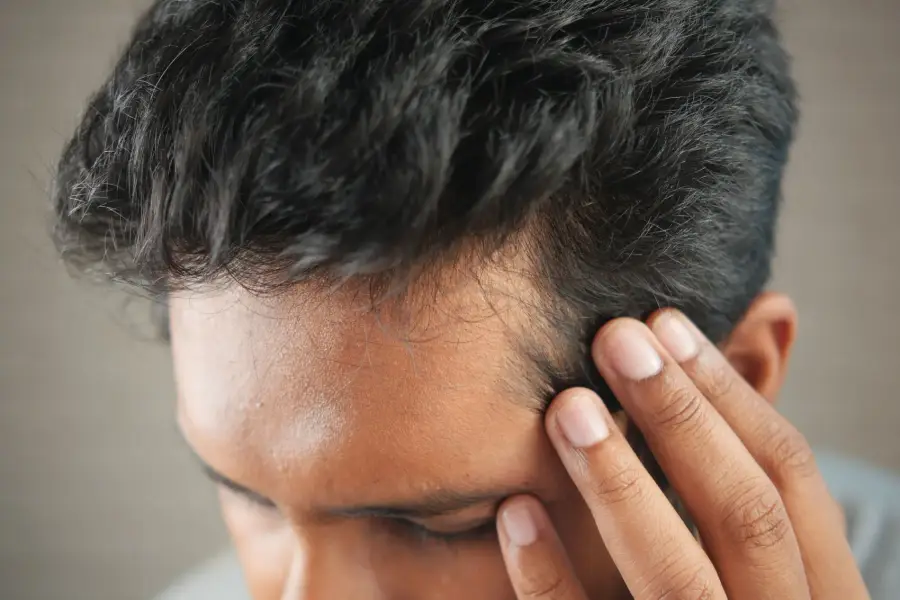
Definition
What is Telogen effluvium?
Every hair goes through its own cycle: a growth phase that lasts for years, a short transition phase and a resting (telogen) phase of about three months. At the end of the resting phase the hair falls out and a new one grows from the same follicle. Normally most of your hair is in the growth phase, and losing 50-100 hairs a day is ordinary. In telogen effluvium, though, a shock to the body pushes a large number of follicles out of the growth phase and into the resting phase at the same time.
That's why shedding doesn't start right after the event but usually 2-3 months later. A high-fever infection, major surgery, a serious accident, intense psychological stress, a crash diet or rapid weight loss, certain medications and nutritional deficiencies are the most common triggers. The heavy shedding many people experienced after COVID-19 is also largely explained by this mechanism. The difference from male pattern hair loss is that the shedding isn't limited to certain areas but spread across the whole head; hair thins everywhere, but no bald patches form.
The good news is that the hair follicles aren't permanently damaged. Once the trigger is gone, shedding usually slows within 3-6 months and the follicles move back into the growth phase. Getting back to your previous density can take 6-12 months, because new hairs take time to grow. If the trigger continues or shedding lasts longer than 6 months, it's called chronic telogen effluvium, and the underlying cause definitely needs to be investigated. Telogen effluvium can also unmask existing male pattern hair loss; so the recovery period is a good opportunity for a proper assessment.
Check yourself
How do you spot it?
- ✓Diffuse shedding across the whole head, not limited to one area
- ✓Noticeably more hairs than usual in the shower, on your comb and on your pillow
- ✓A small white bulb at the base of shed hairs (the follicle in its resting phase)
- ✓Less hair volume and a thinner ponytail or bunch of hair
- ✓Mild thinning at the temples and along the hairline
- ✓In some people, sensitivity, pain or a burning feeling on the scalp
- ✓Several hairs coming out easily with a gentle pull test
- ✓Overall thinning of the hair without bald patches
Why it happens
Main causes
01
Illnesses with high fever
Infections with high fever, such as flu, COVID-19 or typhoid, are among the most common causes that can lead to diffuse shedding months later. Multicenter studies showed that telogen effluvium increased markedly after COVID-19.
02
Rapid weight loss and crash diets
Losing a lot of weight in a short time and sharply cutting calories and protein puts strain on hair follicles. In men with weight-loss-related telogen effluvium, the rate of weight loss was found to be markedly higher than in women. Aggressive «cutting» diets at the gym and rapid weight loss after surgery are risky in this respect.
03
Intense psychological stress
Stress loads like job loss, grief, divorce, a heavy workload or long-term lack of sleep can raise stress hormones in the body and disrupt the hair cycle.
04
Surgery, accidents and heavy physical stress
Major surgery, general anesthesia, serious accidents and blood loss are a heavy burden on the body. Shedding usually starts 2-3 months after these events.
05
Nutritional deficiencies
Iron, zinc, vitamin D and protein deficiencies have been linked to diffuse shedding. Reviews of vitamins and minerals stress that correcting a deficiency is important if there is one, but that evidence for the benefit of random supplements when there's no deficiency is limited.
06
Medications and hormonal changes
Some blood pressure and cholesterol medications, retinoids, changes in thyroid medication and an underactive or overactive thyroid can trigger telogen effluvium. You shouldn't stop a medication without talking to your doctor.
In daily life
Triggers that cause flare-ups
Medical approach
Treatment options
01
Finding the cause
The foundation of treatment is identifying the trigger. Your dermatologist will ask in detail about what you've been through in the past 3-6 months; if needed, they'll check your iron stores, thyroid function, vitamin D and other tests. Once the trigger is gone, shedding often slows down on its own.
02
Correcting deficiencies
If tests show an iron, vitamin D or other deficiency, your doctor will plan the right supplement. Taking high-dose supplements when there's no deficiency may not help; too much of some vitamins can even increase hair loss.
03
Supportive topical options
If shedding lasts a long time or underlying male pattern hair loss has been unmasked, your dermatologist may recommend topical solutions that support hair growth. These products can help support the growth phase.
04
A detailed assessment for chronic telogen effluvium
If shedding lasts longer than 6 months or keeps coming back, your dermatologist will use trichoscopy, hair counts and, if necessary, a biopsy to tell it apart from male pattern hair loss and other causes.
05
Patience and follow-up
After shedding stops, it takes months for new hairs to reach a visible length. During this time, tracking progress with photos is a better approach than panicking and constantly switching products.
Did you know? · Telogen effluvium
3.54 kg/month · In 140 people diagnosed with weight-loss-related telogen effluvium, the average rate of weight loss was 3.54 kg (about 7.8 lb) per month; in men, this rate averaged more than 5 kg (about 11 lb) per month.
Step by step
Care routine for Telogen effluvium
3 steps
- 01
Gentle washing
Wash your hair with lukewarm water and a gentle shampoo with prebiotics. The hairs that come out were already ready to fall; not washing doesn't reduce shedding.
- 02
Pat dry, don't rub
Instead of rubbing your hair hard with a towel, press to dry it. If you use a hair dryer, choose a warm setting and don't hold the hot air close to your scalp.
- 03
A breakfast with protein
Start the day with protein sources like eggs, cheese, yogurt or legumes. Hair follicles need enough building blocks to start working again.

Caution
What to avoid, and when to see a doctor?
Avoid these
- ✕Crash diets, prolonged fasting and protein-poor eating
- ✕High-dose vitamin and biotin supplements without a doctor's recommendation
- ✕Panicking and constantly switching shampoos and serums
- ✕Avoiding washing your hair and letting oil and dirt build up on your scalp
- ✕Tying your hair tightly and brushing it harshly
- ✕Stopping a medication without talking to your doctor
- ✕Products that promise to «stop hair loss in one week»
See a dermatologist
- →If shedding has lasted more than 3 months or keeps increasing
- →If your hair has thinned noticeably or bald patches have formed
- →If you have other complaints such as weakness, palpitations, weight change or feeling cold
- →If shedding started after you began a new medication
- →If you've lost a lot of weight quickly or are worried about an eating disorder
- →If shedding comes with itching, redness or flaking on the scalp
- →If male pattern hair loss runs in your family and recovery isn't going as you expected
Common misconceptions
Myth or fact?
✕Common belief
Stress makes your hair fall out on the spot.
✓Fact
In telogen effluvium, shedding usually starts 2-3 months after the triggering event. Because of this delay, many men link the shedding to their current stress or a new shampoo; the real cause often happened months earlier.
✕Common belief
Hair lost to telogen effluvium never grows back.
✓Fact
In telogen effluvium the follicles aren't permanently damaged. Once the trigger is gone, the follicles move back into the growth phase; getting back to your previous density can take 6-12 months.
✕Common belief
The more vitamins I take, the faster my hair comes back.
✓Fact
Correcting a deficiency is important if you have one; when there's no deficiency, high-dose supplements offer limited benefit. Too much of some vitamins can increase hair loss. The decision to supplement should be made by your doctor based on test results.
Popular searches
Most asked about Telogen effluvium
Your questions
Frequently asked questions
01How long does telogen effluvium last?+
In acute telogen effluvium, shedding usually lasts 3-6 months and slows down on its own once the trigger is gone. Getting back to your previous hair density can take 6-12 months. If shedding lasts longer than 6 months, it's called chronic telogen effluvium and the cause needs to be investigated by a dermatologist.
02How can I reduce hair loss while losing weight?+
The most important steps are losing weight at a controlled rather than fast pace, getting enough protein and not neglecting micronutrients like iron and zinc. If you're planning weight-loss surgery or a very low-calorie diet, having your nutrition monitored by a dietitian and a doctor can help limit hair loss.
03Does hair loss after COVID go away?+
The diffuse shedding seen after COVID-19 is largely telogen effluvium and usually slows down within a few months. But if shedding lasts a long time or underlying male pattern hair loss has been unmasked, you should see a dermatologist.
04How many hairs a day is it normal to lose?+
Losing 50-100 hairs a day is considered normal. On wash days this number can look higher, because resting-phase hairs that built up over several days come out together. What matters is a sudden, noticeable increase in shedding and a visible drop in hair density.
05How can I tell telogen effluvium from male pattern hair loss?+
In telogen effluvium, shedding is diffuse, starts suddenly and is usually linked to a trigger. Male pattern hair loss progresses slowly and is most noticeable at the temples and crown. Because the two can happen together, it's best to have a dermatologist make the definitive distinction.
06What kind of doctor should I see for telogen effluvium?+
For telogen effluvium you should see a dermatologist (skin specialist). Your dermatologist will order the necessary tests; if a thyroid problem, a serious nutritional deficiency or another illness is found, they may refer you to an internal medicine or endocrinology specialist.
Scientific basis
Sources
- 01Telogen Effluvium Associated With Weight Loss: A Single Center Retrospective Study
Kang DH, Kwon SH, Sim WY, Lew BL · Annals of Dermatology · 2024 · doi:10.5021/ad.24.043
In 140 people with weight-loss-related telogen effluvium, the average rate of weight loss was 3.54 kg per month, and this rate was markedly higher in men than in women.
- 02Telogen Effluvium: A Review of the Literature
Asghar F, Shamim N, Farooque U, Sheikh H, Aqeel R · Cureus · 2020 · doi:10.7759/cureus.8320
Summarized that telogen effluvium can be triggered by medications, trauma, and emotional and physiological stress, and that finding and removing the cause is the core of treatment.
- 03Telogen effluvium: a comprehensive review
Rebora A · Clinical, Cosmetic and Investigational Dermatology · 2019 · doi:10.2147/CCID.S200471
Discussed the classification of telogen effluvium, how to tell it apart from male pattern hair loss and the importance of care and empathy in approaching patients.
- 04Telogen Effluvium: A Review
Malkud S · Journal of Clinical and Diagnostic Research · 2015 · doi:10.7860/JCDR/2015/15219.6492
Reviewed how telogen effluvium develops through a shift in the hair cycle, how shedding starts months after the trigger and often resolves on its own.
- 05SARS-CoV-2-induced telogen effluvium: a multicentric study
Moreno-Arrones OM, Lobato-Berezo A, Gomez-Zubiaur A, Arias-Santiago S, Saceda-Corralo D, Bernardez-Guerra C, Grimalt R, Fernandez-Crehuet P, Ferrando J, Gil R, Hermosa-Gelbard A, Rodrigues-Barata R, Fernandez-Nieto D, Merlos-Navarro S, Vañó-Galván S · Journal of the European Academy of Dermatology and Venereology · 2021 · doi:10.1111/jdv.17045
A multicenter study in Spain described telogen effluvium starting a few months after infection in patients who had COVID-19.
- 06The Role of Vitamins and Minerals in Hair Loss: A Review
Almohanna HM, Ahmed AA, Tsatalis JP, Tosti A · Dermatology and Therapy · 2019 · doi:10.1007/s13555-018-0278-6
Highlighted that deficiencies of nutrients such as iron, vitamin D and zinc may be linked to hair loss, and that evidence for supplementing without a deficiency is limited.
- 07Stress and the Hair Growth Cycle: Cortisol-Induced Hair Growth Disruption
Thom E · Journal of Drugs in Dermatology · 2016
Reviewed how the stress hormone may negatively affect the hair follicle's cycle and the supporting tissue around the follicle.
- 08Telogen effluvium
DermNet · DermNet NZ · 2023
Explained the triggers of telogen effluvium, the shedding that typically starts 2-3 months after the event and that hair usually grows back on its own.