Definition
What is Dandruff?
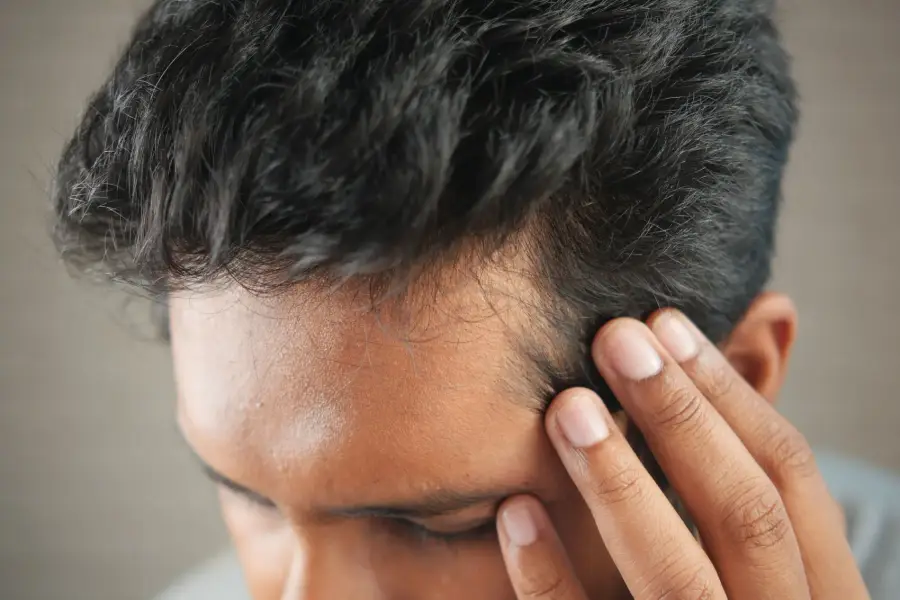
Dandruff happens when cells in the outermost layer of the scalp renew faster than normal and shed as visible white or yellowish flakes. A healthy scalp renews itself constantly too; but those dead cells come off one by one and are too small to see. With dandruff, cells shed in clumps stuck together and show up on your shoulders, collar and at the roots of your hair. Itching often comes along with it.
In the dermatology literature, dandruff is considered the mild end of the same spectrum as seborrheic dermatitis. Dandruff is limited to the scalp and has no obvious redness. Seborrheic dermatitis, by contrast, brings redness and thicker, greasier scales, and can spread between the eyebrows, to the sides of the nose, the beard area and behind the ears. Because men's oil glands are more active under the influence of hormones, both dandruff and seborrheic dermatitis are more common and more stubborn in men than in women.
Dandruff has three main players: sebum secreted by the oil glands, a type of yeast that naturally lives on everyone's scalp, and your own predisposition. The yeast breaks down the fats in sebum; some of the resulting fatty acids irritate the scalp in predisposed people, weaken the barrier and speed up cell turnover. That's why dandruff isn't contagious, isn't caused by being dirty and can be largely controlled with the right care. But because it's an ongoing tendency, it can come back when you take a break.
Check yourself
How do you spot it?
- ✓White or yellowish flakes at the roots of your hair and on your shoulders
- ✓Itching, especially on the crown and the back of the head
- ✓A feeling of tightness or mild burning on the scalp
- ✓Flaking that quickly increases 1-2 days after washing
- ✓With oily dandruff, yellowish, greasy flakes that stick to the roots
- ✓With dry dandruff, finer white flakes that fall like powder
- ✓Flaking that also affects the eyebrows, sides of the nose or under the beard (may point to seborrheic dermatitis)
- ✓A clear flare-up in winter and during stressful periods
Why it happens
Main causes
01
Excess sebum
Male hormones stimulate the oil glands. Men's skin and scalp produce more sebum than women's, which creates a rich environment for the yeast associated with dandruff to feed on. That's why dandruff starts at puberty and is more common in men.
02
Scalp yeast and predisposition
The yeast that lives on everyone's scalp breaks down the fats in sebum. In predisposed people, the fatty acids released in this process irritate the scalp and trigger rapid cell turnover. Although the exact reason for this predisposition isn't fully known, barrier structure and immune response play an important role.
03
A weak scalp barrier
Frequent hot water, harsh and very foamy shampoos, alcohol-based hair tonics and heavy use of styling products thin out the scalp's protective layer. A scalp with a weak barrier reacts more sensitively to yeast by-products and outside factors.
04
Washing too little or the wrong way
Washing your hair too rarely leads to a buildup of sebum and dead cells; washing often with very hot water and harsh products, on the other hand, dries out the scalp. Both extremes can make dandruff worse. The right frequency depends on how quickly your scalp gets oily.
05
Season, stress and lack of sleep
In winter, dry indoor air and hot water put strain on the barrier. A heavy workload, lack of sleep and stress can also affect immune balance and oil production, contributing to dandruff flare-ups.
06
Helmets, beanies and sweating
A motorcycle helmet, a hard hat at work or a beanie worn during sports creates a warm, humid environment on the scalp. When sweat and oil stay on the scalp for a long time, it becomes easier for the yeast to multiply.
In daily life
Triggers that cause flare-ups
Medical approach
Treatment options
01
Anti-dandruff shampoos
The first step is dandruff shampoos with an antifungal effect or zinc, which help reduce the amount of scalp yeast. These shampoos need to sit on the scalp for a few minutes; lathering and rinsing right away reduces their effect. Your dermatologist can set how many times a week to use them and for how long.
02
Scale softeners
For thick, stuck-on flakes, shampoos or products with a scale softener such as salicylic acid can help soften and remove built-up dead cells. By lifting the flakes, these products make it easier for the other care steps to reach the scalp.
03
Rotation and maintenance
Once dandruff is under control, you use the medicated shampoo less often and add a gentle shampoo in between. Some dermatologists may recommend alternating shampoos with different active ingredients. The goal is to keep dandruff from coming back without drying out the scalp.
04
Prescription treatment for inflamed cases
If there's obvious redness, thick scales and intense itching, the picture may point to seborrheic dermatitis. In that case your dermatologist may recommend short courses of anti-inflammatory lotions or prescription antifungal products. These are used after a doctor's assessment and for set periods of time.
05
Ruling out other conditions
Psoriasis, scalp fungal infection or contact dermatitis can also cause flaking and itching. If dandruff shampoos don't help within a few weeks, or if you have thick, silvery plaques, your dermatologist needs to tell these conditions apart.
Did you know? · Dandruff
Up to half · Dandruff is an itchy, flaky scalp condition that affects up to half of the world's post-pubertal population.
Step by step
Care routine for Dandruff
4 steps
- 01
Wash based on oiliness
If your scalp gets oily quickly, wash every day or every other day with lukewarm water. On days you don't use dandruff shampoo, choose a gentle shampoo with prebiotics.
- 02
Let the dandruff shampoo sit
On dandruff-shampoo days, massage the product into your scalp and leave it on for 3-5 minutes. You can use that time to wash your face and body in the shower.
- 03
Conditioner on the lengths only
If you use conditioner, apply it from ear level to the ends, not to the scalp. Heavy conditioner residue left on the scalp can increase flaking.
- 04
Light styling
Choose light, water-soluble products instead of heavy oil-based wax. Apply the product to the mid-lengths and ends, not the roots.
Caution
What to avoid, and when to see a doctor?
Avoid these
- ✕Lathering dandruff shampoo and rinsing it off right away
- ✕Washing your hair with very hot water
- ✕Alcohol-based hair tonics and heavily fragranced products
- ✕Applying thick layers of olive oil, coconut oil or other oils to the scalp and leaving them on
- ✕Scratching with your nails or the sharp teeth of a comb
- ✕Going to bed or putting on a helmet/beanie with wet hair
- ✕Dropping your maintenance shampoo completely because the dandruff is gone
- ✕Rubbing your scalp with lemon, vinegar or baking soda
See a dermatologist
- →If there's no improvement after 4-6 weeks of regular use of dandruff shampoos
- →If there's obvious redness, thick yellow scales or oozing on your scalp
- →If flaking has spread to your eyebrows, sides of the nose, beard and behind the ears
- →If you've noticed thick, silvery plaques with sharp borders
- →If dandruff comes with noticeable or patchy hair loss
- →If itching is bad enough to disrupt your sleep and daily life
Common misconceptions
Myth or fact?
✕Common belief
Dandruff comes from being dirty; men who wash often don't get it.
✓Fact
Dandruff isn't a hygiene problem; it comes from a combination of sebum, scalp yeast and personal predisposition. Men who wash their hair every day can get dandruff too; choosing the right shampoo matters more than how often you wash.
✕Common belief
Dandruff comes from a dry scalp, so applying oil fixes it.
✓Fact
Dandruff is usually seen on an oily scalp, and the yeast feeds on the fats in sebum. Applying a thick layer of oil to the scalp can make dandruff worse. Flaking from a dry scalp is a separate condition and responds better to moisturizing care.
✕Common belief
Dandruff is contagious.
✓Fact
The yeast associated with dandruff naturally lives on everyone's scalp; dandruff doesn't spread from person to person. Still, not sharing combs and towels is a good habit for general scalp hygiene.
Popular searches
Most asked about Dandruff
Your questions
Frequently asked questions
01Can dandruff go away for good?+
Dandruff is an ongoing condition that tends to recur; so the goal isn't to wipe it out once and for all but to keep it under control. With the right shampoo, regular use and barrier-supporting care, dandruff decreases noticeably in most men. If you stop treatment completely, it can come back, especially in winter and during stressful periods.
02Can I use dandruff shampoo every day?+
Most dandruff shampoos are used 2-3 times a week at first, with a gentle shampoo on the other days. Using one every day can dry out the scalp and cause irritation in some men. Adjust how often you use it based on the product label and your dermatologist's advice.
03Does dandruff cause hair loss?+
Dandruff itself doesn't permanently destroy hair follicles. But intense itching, scratching and an inflamed scalp can increase shedding and make existing male pattern hair loss look more obvious. If you notice significant hair loss along with dandruff, see a dermatologist.
04Can you get dandruff in your beard?+
Yes. The beard area is rich in oil glands, and flaking and itching similar to scalp dandruff can also show up under the beard. This often points to seborrheic dermatitis in the beard area; washing your beard with a gentle cleanser and then using a light beard oil or moisturizer can bring relief.
05Does stress make dandruff worse?+
Many men notice their dandruff gets worse during exams, busy work periods or sleepless weeks. Stress can affect immune balance and oil production and contribute to dandruff flare-ups. Managing stress and getting regular sleep are supportive parts of dandruff care.
06What kind of doctor should I see for dandruff?+
For dandruff you should see a dermatologist (skin specialist). Your dermatologist will tell dandruff apart from similar conditions like seborrheic dermatitis, psoriasis or scalp fungal infection and recommend the right shampoo or treatment plan for you.
Scientific basis
Sources
- 01Stratum corneum dysfunction in dandruff
Turner GA, Hoptroff M, Harding CR · International Journal of Cosmetic Science · 2012 · doi:10.1111/j.1468-2494.2012.00723.x
Showed that in dandruff, which affects up to half of the world's post-pubertal population, scalp barrier lipids are reduced and water loss is increased.
- 02Seborrheic Dermatitis and Dandruff: A Comprehensive Review
Borda LJ, Wikramanayake TC · Journal of Clinical and Investigative Dermatology · 2015 · doi:10.13188/2373-1044.1000019
Summarized that dandruff and seborrheic dermatitis lie on the same disease spectrum, with sebum, yeast and individual predisposition all playing a role.
- 03A comprehensive pathophysiology of dandruff and seborrheic dermatitis - towards a more precise definition of scalp health
Schwartz JR, Messenger AG, Tosti A, Todd G, Hordinsky M, Hay RJ, Wang X, Zachariae C, Kerr KM, Henry JP, Rust RC, Robinson MK · Acta Dermato-Venereologica · 2013 · doi:10.2340/00015555-1382
Showed that in dandruff the scalp barrier is disrupted and inflammatory markers are increased, and that a healthy scalp can be defined by these measures.
- 04Comparison of Healthy and Dandruff Scalp Microbiome Reveals the Role of Commensals in Scalp Health
Saxena R, Mittal P, Clavaud C, Dhakan DB, Hegde P, Veeranagaiah MM, Saha S, Souverain L, Roy N, Breton L, Misra N, Sharma VK · Frontiers in Cellular and Infection Microbiology · 2018 · doi:10.3389/fcimb.2018.00346
Showed that bacterial and fungal communities differ between healthy and dandruff-prone scalps and that beneficial bacteria may contribute to scalp balance.
- 05Dandruff is associated with the conjoined interactions between host and microorganisms
Xu Z, Wang Z, Yuan C, Liu X, Yang F, Wang T, Wang J, Manabe K, Qin O, Wang X, Zhang Y, Zhang M · Scientific Reports · 2016 · doi:10.1038/srep24877
Reported that dandruff severity is closely linked to the scalp's oil and moisture levels and especially to bacterial balance.
- 06The positive benefit of Lactobacillus paracasei NCC2461 ST11 in healthy volunteers with moderate to severe dandruff
Reygagne P, Bastien P, Couavoux MP, Philippe D, Renouf M, Castiel-Higounenc I, Gueniche A · Beneficial Microbes · 2017 · doi:10.3920/BM2016.0144
In 60 men with moderate to severe dandruff, a probiotic taken by mouth for 56 days reduced dandruff and redness compared with placebo and helped rebalance the scalp microbiota.
- 07Male versus female skin: What dermatologists and cosmeticians should know
Rahrovan S, Fanian F, Mehryan P, Humbert P, Firooz A · International Journal of Women's Dermatology · 2018 · doi:10.1016/j.ijwd.2018.03.002
Reviewed evidence that men's skin produces more sebum than women's and that androgens are the key factor behind this difference.
- 08Dandruff
NHS · NHS (National Health Service) · 2023
Explained that dandruff isn't contagious, can be controlled with dandruff shampoos, and that you should see a doctor if it doesn't improve.
- 09How to treat dandruff
American Academy of Dermatology · American Academy of Dermatology Association · 2024
Advised leaving dandruff shampoo on the scalp for a few minutes and noted that shampoos with different active ingredients can be alternated.