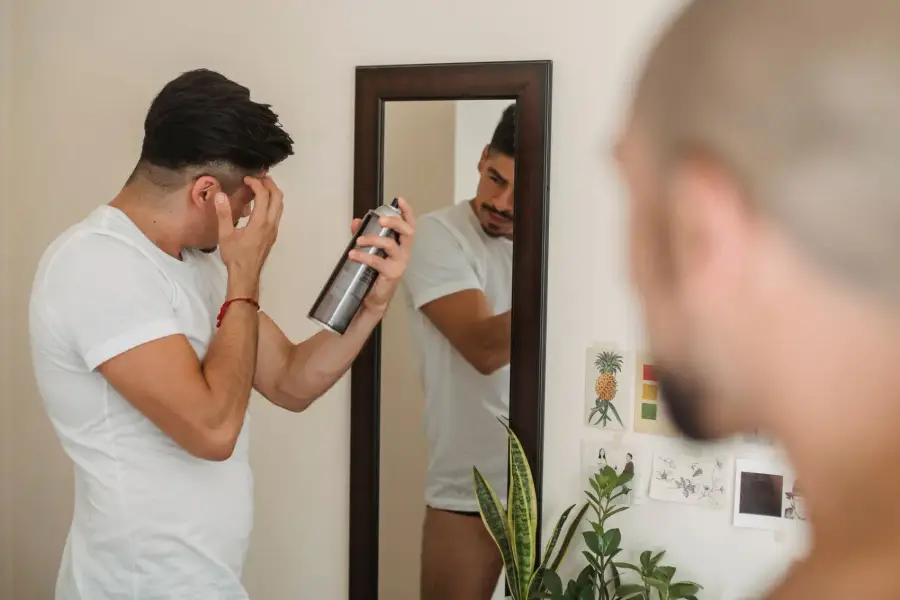
Self-test
Is this type yours?
- ◎You can easily feel a single hair strand between your fingers; the strand is thick and coarse.
- ◎Even with a short cut, your hair sticks straight up or puffs out to the sides.
- ◎Drying your hair takes a long time; if you don't blow-dry it, it stays damp for hours.
- ◎Your barber says your hair won't sit right after a cut unless it's thinned out.
- ◎When you use wax or clay, light products don't hold your hair and the style falls apart within a few hours.
- ◎When you take off a helmet or cap, your hair looks permanently crushed in one direction.
In depth
What happens at the root?
Hair thickness describes two different things: strand diameter and hair density, meaning the number of strands per unit of area. In thick-stranded hair the cortex layer is wide, and there is often a medulla at the very center; this strand is stronger but coarser and resists bending. In dense hair, a large number of strands push against each other and the hair stands full as a whole. Research shows that hair density, growth rate and strand diameter vary markedly between populations and between individuals; in other words, how thick your hair is is largely an inherited trait.
Thick hair sticks up and puffs out because of the stiffness of the strand and the angle of the follicle. In a short cut, the strand isn't long enough to give in to gravity, so it stands at the angle of the follicle. A thick strand takes up water more slowly and releases it more slowly; that's why drying takes a long time and the strand stays in the direction it dried. The direction your hair dries in determines how it will sit all day. Even though a thick strand looks sturdy, hard water, frequent heat and harsh shampoos can roughen its surface and make hair look duller and puffier. The goal of care is to soften the strand, direct it while drying and lock in the shape with a strong hold.
Priorities
What does it need?
01
The right haircut
With thick hair, the cut is everything. When your barber removes weight from the right places and adds layers, it clearly reduces puffiness and hair sticking up.
02
Softening
Thick strands feel coarse and dry. Using conditioner softens the strand, reduces frizz and makes combing easier.
03
Directing while drying
Thick hair stays in the direction it dries. Combing it the way you want while wet and drying it in that direction cuts your styling product's job in half.
04
Strong hold
Light products can't carry thick hair. You need a medium- or strong-hold paste, clay or pomade.
05
Reaching the scalp
With dense hair, shampoo has a hard time reaching the scalp. Scrubbing your scalp well with your fingertips and rinsing thoroughly reduces buildup.
Thick and dense hair
The right haircut
Step by step
Your care routine
4 steps
- 01
Wet your hair thoroughly
Thick hair absorbs water slowly. Before shampooing, make sure your hair and scalp are completely wet; the shampoo spreads better.
- 02
Reach the scalp
Apply shampoo to your scalp section by section and scrub with your fingertips. If needed, lather a second time with a small amount.
- 03
Don't skip conditioner
Even when it's short, a light conditioner softens thick hair and makes styling easier. Keep the conditioner away from the roots.
- 04
Rinse thoroughly
Leftover shampoo and conditioner in dense hair can cause itching and a dandruff-like feeling. Rinse long and carefully.
What you can add to your routine
The scalp under dense hair stays damp easily
Dense hair reduces airflow to the scalp. A scalp that stays damp for a long time and sweat under a helmet can set the stage for a shift in the balance of microorganisms. After washing, it's important to dry your hair all the way to the roots.
Product buildup
When strong-hold products reach the scalp, they can build up and cause itching. Applying product to the strands rather than the roots and clarifying regularly preserves balance.
Reading labels
Ingredient guide
✓What helps
- Shampoos with gentle surfactants: clean thick strands without drying them out.
- Softening conditioner ingredients (cationic conditioners, light silicones): soften the strand and reduce frizz.
- Glycerin and panthenol: make coarse strands more flexible.
- Medium- and strong-hold paste, clay and pomade: help thick hair hold its shape.
- Water-based pomades: give strong hold and wash out easily in the evening.
- Shampoos with prebiotics: can help support microbiome balance on the scalp under dense hair.
!Be careful with
- Shampoos with strong sulfates: can make thick strands even coarser and puffier.
- Light, liquid-hold products: don't hold thick hair, which leads to overuse.
- Poorly water-soluble oil-based pomades: can build up on the scalp without regular clarifying.
- Very hot blow dryers: dry out thick strands and roughen their surface.
- Hard water: minerals can make hair feel duller and coarser.
Caution
Common mistakes
- ✕Letting your hair dry on its own without combing it while wet.
- ✕Trying to hold thick hair with light products and adding product layer after layer.
- ✕Going longer between haircuts and letting your hair get heavy.
- ✕Thinking conditioner is unnecessary for short hair.
- ✕Leaving the roots of dense hair wet and putting on a helmet or beanie.
- ✕Over-thinning your hair to remove weight and damaging the ends.
Popular searches
Most asked about Thick and dense hair
Your questions
Frequently asked questions
01How can I make my hair stop sticking up?+
Combing your hair the way you want while wet and drying it in that direction is the most effective way; thick hair stays in the direction it dries. Hold the blow dryer in that direction, finish with cool air to lock it in, then apply a strong-hold paste or pomade. For areas that stick up like a cowlick, having your barber leave that spot a little longer also helps.
02Does thick hair need conditioner?+
Yes, even when it's short. Conditioner softens thick strands, reduces frizz and makes styling easier. Just keep it away from the roots and rinse it out well.
03Should thick hair be thinned out?+
If done right, yes; removing weight reduces puffiness. But over-thinning can make the ends look broken and frizzy. Removing weight with a layered cut and from the right spots gives better results.
04What's the best styling product for thick hair?+
If you want a matte look, a strong-hold clay or paste is a good choice; for a sleeker look with a slight shine, a water-based pomade works well. Light creams and sea salt sprays usually don't hold thick hair enough.
05Does hard water affect thick hair?+
One study with hard water found that hair strands lost strength; in other studies the effect was more limited. If your hair feels dull and coarse, a weekly clarifying wash and regular conditioner help.
Scientific basis
Sources
- 01Diversity of hair growth profiles
Loussouarn G, El Rawadi C, Genain G · International Journal of Dermatology 44(s1):6-9 · 2005 · doi:10.1111/j.1365-4632.2005.02800.x
Showed through measurements that hair density, growth rate and strand diameter vary markedly across different populations.
- 02Shampoos: ingredients, efficacy and adverse effects
Trüeb RM · Journal der Deutschen Dermatologischen Gesellschaft 5(5):356-365 · 2007 · doi:10.1111/j.1610-0387.2007.06304.x
Examines, from a dermatological perspective, the effectiveness and possible side effects of the surfactants, conditioning agents and preservatives found in shampoos.
- 03Hair shaft damage from heat and drying time of hair dryer
Lee Y, Kim YD, Hyun HJ, Pi LQ, Jin X, Lee WS · Annals of Dermatology 23(4):455-462 · 2011 · doi:10.5021/ad.2011.23.4.455
Showed that using a hair dryer very close to the hair and at high heat increases cuticle damage, while drying from about 15 cm (6 inches) away with constant movement clearly reduces the damage.
- 04To evaluate and compare changes in baseline strength of hairs after treating them with deionized water and hard water and its role in hair breakage
Luqman MW, Ramzan MH, Javaid U, Ali R, Shoaib M, Luqman MA · International Journal of Trichology 10(3):113-117 · 2018 · doi:10.4103/ijt.ijt_115_16
Measured, in hair samples from young men, that strands treated with hard water lost significantly more tensile strength than those treated with deionized water.
- 05The impact of shampoo wash frequency on scalp and hair conditions
Punyani S, Tosti A, Hordinsky M, Yeomans D, et al. · Skin Appendage Disorders 7(3):183-193 · 2021 · doi:10.1159/000512786
Questioned the belief that frequent washing damages hair and reported that increasing wash frequency according to scalp condition can improve scalp comfort and appearance.
- 06Tips for healthy hair
American Academy of Dermatology · AAD Public Education · 2024
Offers basic care advice such as choosing a shampoo for your hair type, focusing shampoo on the scalp, using conditioner after every wash and protecting hair from the sun.