Self-test
Is this type yours?
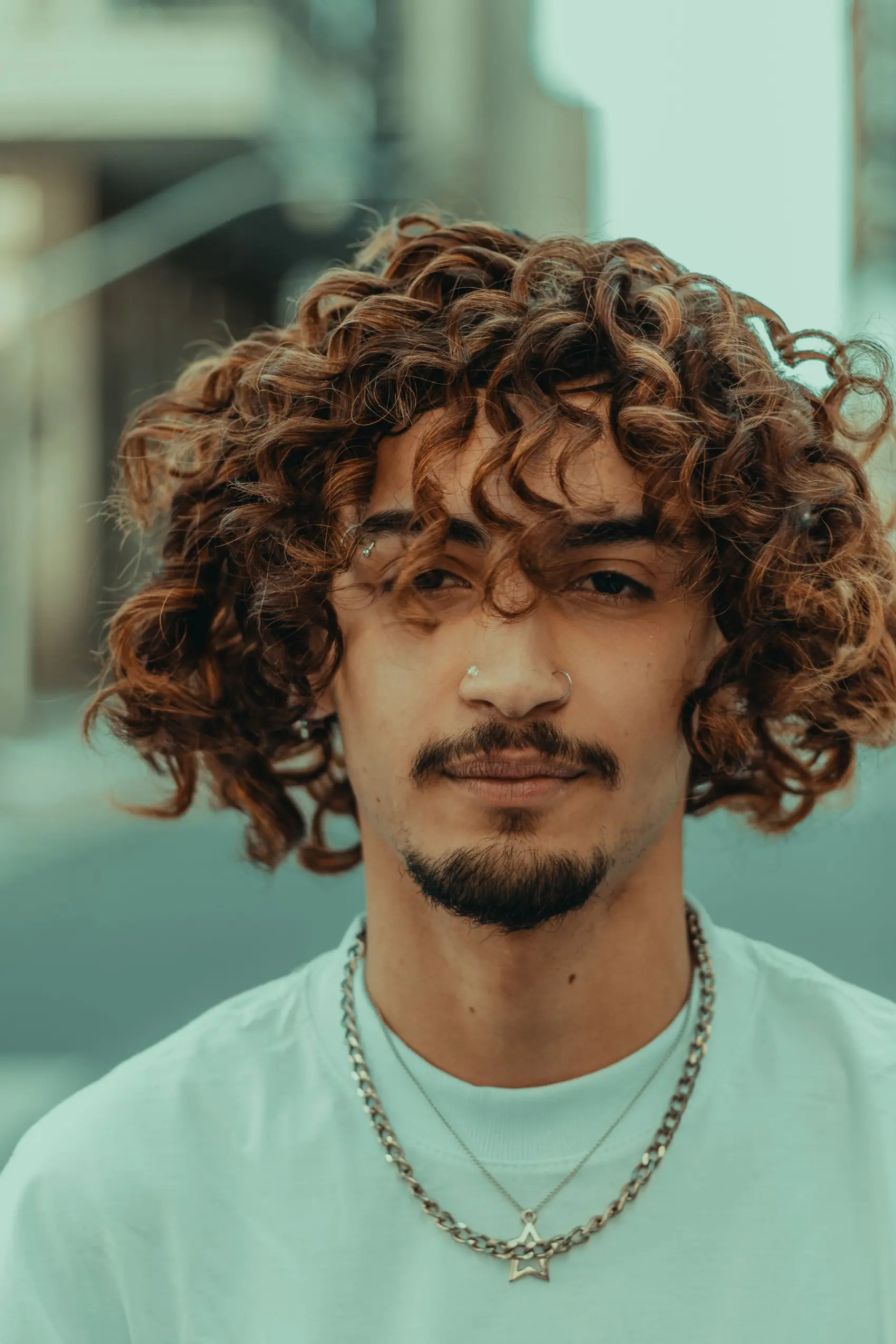
- ◎When your hair dries, clear ringlets or tight coils form starting right from the roots.
- ◎Your hair feels rough and dry to the touch and doesn't shine under light the way straight hair does.
- ◎When you comb it dry, its volume doubles and it completely loses its shape.
- ◎Your hair looks much shorter than its actual length; the curls take up the length.
- ◎After shaving, bumps and hairs growing back into the skin appear on your neck, sideburns or beard area.
- ◎Your hair doesn't look greasy even days after washing, but the ends break.
In depth
What happens at the root?
Curly hair grows from a clearly curved follicle, and its cross-section is a flattened oval. Because the cells and proteins on each side of the strand are distributed differently, the strand twists around itself and forms tight curls. This structure has two consequences. First, the sebum produced by the scalp gets caught in the curls and can't travel down the strand; that's why the strands stay dry even when the scalp is normal or oily. Second, each bend is a mechanically weak point; during combing, friction and pulling, the strand breaks most often at these points.
A curved follicle affects not only the hair on your head but also your beard and neck hair. As it grows, the curled hair tip, sharpened by shaving, can turn back and pierce the skin, leading to inflamed bumps at the base of the hair. This is clearly more common in men with curly hair and gets worse with very close shaving. On the scalp side, dry scalp, itching and flaking are common in people with curly hair, and very harsh shampoos can make this worse. The foundation of curly hair care is to cleanse the scalp gently while giving the strands plenty of moisture and keeping mechanical wear to a minimum.
Priorities
What does it need?
01
Plenty of moisture
Because sebum can't reach the strand, curly hair needs moisture from outside. Rich conditioners, leave-in creams and light oils are its basic needs.
02
Gentle cleansing
Harsh shampoos dry out an already dry strand even more. A gentle shampoo that focuses on the scalp, or a non-foaming cleansing cream in between, is a good fit.
03
Less mechanical wear
Curly hair isn't combed dry. Detangling while wet, with conditioner in and with a wide-tooth comb, clearly reduces breakage.
04
Curl definition
A combination of cream and gel keeps curls together, reduces frizz and makes the style last all day.
05
Neckline and beard line
Curled hairs easily grow back into the skin after shaving. Leaving the neckline and sideburns short instead of shaving them down to the skin can help reduce the risk of ingrown hairs.
Curly hair
Plenty of moisture
Step by step
Your care routine
3 steps
- 01
Clean the scalp, protect the strand
Apply shampoo only to the scalp and massage with your fingertips. Let the foam run down without scrubbing the lengths.
- 02
Wash less, rinse on workout days
For curly hair, shampooing two or three times a week is usually enough. If your scalp got sweaty after a workout, you can use a gentle shampoo or non-foaming cleanser on the scalp and just conditioner on the lengths.
- 03
Plenty of conditioner
Apply a generous amount of conditioner to the lengths, work out the knots with your fingers and a wide-tooth comb, leave it on for a few minutes and rinse with lukewarm water.
What you can add to your routine
Balancing infrequent washing
Curly hair gets washed less often, but the scalp still produces oil and sweat. Going too long between washes can lead to buildup on the scalp and upset the balance of microorganisms. Remember that you can clean your scalp without washing the strands.
Heavy products and the scalp
Heavy oils and creams applied to the scalp can create a nourishing environment for scalp yeast. Keeping oils for the strands and cleanser for the scalp preserves balance.
Reading labels
Ingredient guide
✓What helps
- Gentle surfactants and non-foaming cleansing creams: clean the scalp without drying out the strand.
- Humectants (glycerin, panthenol): soften the strand by holding water.
- Light to medium-weight oils (e.g., coconut oil, jojoba oil): seal in moisture at the ends and reduce friction.
- Hydrolyzed proteins: can improve the feel of strength in the fragile spots of a curly strand.
- Styling gels (low in alcohol): hold curls together without drying them out.
- Scalp care products with prebiotics: can help support microbiome balance on a dry, itchy scalp.
!Be careful with
- Strong sulfates: quickly dry out and stiffen curly hair.
- Heavily alcohol-based gels and sprays: can increase dryness and breakage.
- Using a brush on dry hair: breaks up curls and snaps the strand.
- Very hot blow dryers and flat irons: can cause lasting damage at the bends.
- Applying heavy oils to the scalp: can set the stage for dandruff and itching.
Caution
Common mistakes
- ✕Combing or brushing curly hair while it's dry.
- ✕Washing every day with a harsh shampoo.
- ✕Shaving the neckline and beard line down to the skin every day; this increases the risk of ingrown hairs.
- ✕Trying to force out ingrown hairs with tweezers or your fingernails.
- ✕Applying heavy oils to the scalp.
- ✕Using alcohol-based gels without a cream underneath.
Popular searches
Most asked about Curly hair
Your questions
Frequently asked questions
01How often should curly hair be washed?+
For most curly hair, shampooing two or three times a week is enough. If you work out every day, you can use a gentle cleanser on the scalp and just conditioner on the lengths in between. The goal is to keep the scalp clean and the strands moisturized.
02Why is curly hair so dry?+
The curls prevent the oil produced by your scalp from traveling down the strand. That's why the strands stay dry even if your scalp is normal. Conditioner, leave-in cream and light oils make up for this from the outside.
03Why do I get ingrown hairs on my neck and beard?+
As a curled hair grows with its tip sharpened by shaving, it can turn back into the skin and form a bump. This is more common in men with curly hair. Stopping very close shaves, keeping hair short with clippers and shaving in the direction of hair growth can help reduce the risk. If the bumps are frequent and inflamed, it's a good idea to see a dermatologist.
04Gel or cream for curly hair?+
The best results usually come from using both: first a moisturizing cream, then a gel on top to hold the curls. Cream alone may not fully control frizz, and gel alone can cause dryness.
05Does a short cut make curly hair easier to care for?+
A short cut makes daily styling easier but doesn't eliminate your hair's need for moisture. Also, having the neckline and sideburns taken down very close can increase the risk of ingrown hairs; you can ask your barber to leave that area a bit longer.
Scientific basis
Sources
- 01The what, why and how of curly hair: a review
Cloete E, Khumalo NP, Ngoepe MN · Proceedings of the Royal Society A 475:20190516 · 2019 · doi:10.1098/rspa.2019.0516
Brings together why hair curls, the structure of a curly strand and its mechanical behavior, concluding that curl is a multilayered trait that starts at the hair follicle.
- 02Worldwide diversity of hair curliness: a new method of assessment
Loussouarn G, Garcel AL, Lozano I, et al. · International Journal of Dermatology 46(s1):2-6 · 2007 · doi:10.1111/j.1365-4632.2007.03453.x
Introduced a method that classifies hair curl by measures such as curve diameter and number of waves, and showed a wide worldwide diversity ranging from straight to very tightly coiled.
- 03Pseudofolliculitis barbae; current treatment options
Ogunbiyi A · Clinical, Cosmetic and Investigational Dermatology 12:241-247 · 2019 · doi:10.2147/CCID.S149250
Explains that razor bumps, caused by the curled tip of a hair growing back into the skin after shaving or plucking, are more common with curly hair follicles and usually subside when shaving is paused.
- 04Pseudofolliculitis barbae
DermNet · DermNet NZ · 2023
Explains the causes of the bumps that form when curled beard hairs grow back into the skin, that they are more common in men with curly hair, and why shaving habits matter.
- 05Human hair and the impact of cosmetic procedures: a review on cleansing and shape-modulating cosmetics
Cruz CF, Costa C, Gomes AC, Matamá T, Cavaco-Paulo A · Cosmetics 3(3):26 · 2016 · doi:10.3390/cosmetics3030026
A review of how shampooing and shape-changing treatments affect the cuticle and cortex of the hair shaft.
- 06Hair cosmetics: an overview
Gavazzoni Dias MF · International Journal of Trichology 7(1):2-15 · 2015 · doi:10.4103/0974-7753.153450
A comprehensive review that summarizes, from a dermatological perspective, the ingredients of hair cosmetics such as shampoos, conditioners and styling products and their effects on the hair shaft.
- 07Tips for healthy hair
American Academy of Dermatology · AAD Public Education · 2024
Offers basic care advice such as choosing a shampoo for your hair type, focusing shampoo on the scalp, using conditioner after every wash and protecting hair from the sun.