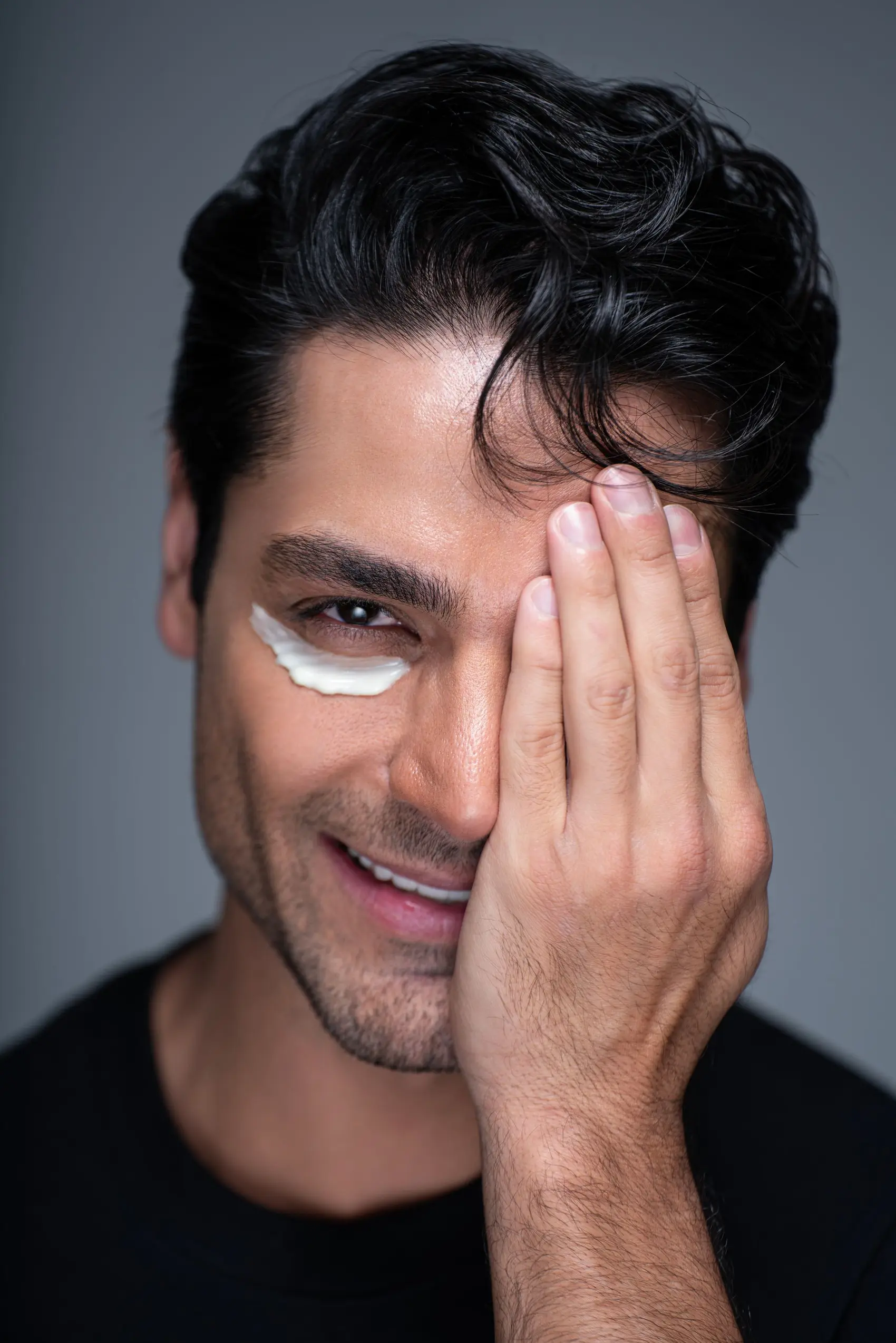
Definition
What is Dark circles and under-eye bags?
The under-eye area has the thinnest skin on your face; it's several times thinner than the skin on your cheeks, with fatty tissue, muscles and a dense network of blood vessels underneath. That's why the under-eye area is the first place to give away small changes in your body. What we call an «under-eye problem» is really a shared name for several different conditions, each with its own cause and solution.
Dark circles come mainly from three sources. The first is pigment: brownish darkness caused by excess melanin around the eyes; it's linked to genetics and sun and is more common in olive and darker skin tones. The second is vascular: blood vessels showing through thin skin and slowed blood flow give a blue-purple color; this gets more obvious with lack of sleep and fatigue. The third is structural: a hollow under the eye (tear trough), present from birth or developing with age, casts a shadow and looks like a dark circle under light. One study found that family history was the most important risk factor for dark circles, while the pigment melanin was the dominant driver of the darkness.
Under-eye bags and puffiness are a different picture. Puffiness that's obvious in the morning and fades during the day usually comes from fluid buildup; salty food, alcohol, allergies and sleeping face down make it worse. Permanent bags, on the other hand, form with age as the tissues that hold the eye area in place loosen and the fat pad in the eye socket moves forward. In men, a heavy work pace, screen time late into the night, smoking, alcohol and hours spent squinting in the sun can make these conditions more noticeable. Simple lifestyle changes and the right care narrow the difference for many men; for structural causes, dermatological and aesthetic options come into play.
Check yourself
How do you spot it?
- ✓Brownish dark circles under the eyes (pigment-related)
- ✓Blue-purple darkness that gets worse with lack of sleep (vascular)
- ✓A hollow, shadowed look between the under-eye area and the cheek
- ✓Puffiness that's obvious in the morning and fades during the day
- ✓Permanent bags that last all day and become more noticeable with age
- ✓Fine lines and dryness around the eyes
- ✓Itching, watering and darkening during allergy season
- ✓Looking generally tired, sleep-deprived and older than your age
Why it happens
Main causes
01
Genetics and skin structure
The strongest predictor of dark circles is family history. Thin skin, deep-set eyes, a pronounced tear trough and excess pigment around the eyes can run in families. That's why in some men dark circles become noticeable in their 20s and don't go away completely with sleep.
02
Lack of sleep and fatigue
Studies that evaluated photos of sleep-deprived people found that lack of sleep shows up on the face as droopy eyelids, red and swollen eyes, dark circles and paler skin, and that these people were perceived as more tired and less healthy.
03
Alcohol and salt
Alcohol disrupts the body's water balance, widens blood vessels and lowers sleep quality. A large survey study found that having 8 or more drinks a week was linked to various signs of facial aging, especially under-eye puffiness. Salty food eaten at night also increases morning puffiness.
04
Screens and eye strain
Screen use late into the night both delays falling asleep and reduces how often you blink, leading to eye strain. This can increase the urge to rub your eyes and the tired look in the morning.
05
Aging and shifting fat pads
With age, the connective tissue that holds the eye area in place loosens and the fat pad in the eye socket moves forward, forming bags. Imaging studies have shown that fat volume in the eye socket increases with age and contributes to lower eyelid bags.
06
Smoking and sun
Smoking speeds up collagen breakdown and reduces blood flow; it's linked to under-eye puffiness and lines around the eyes. Hours spent squinting in the sun and unprotected sun exposure also increase pigment and wrinkles around the eyes.
07
Allergies and health problems
Allergic rhinitis, chronic nasal congestion, iron deficiency, thyroid problems and kidney disease can also cause darkening or puffiness under the eyes. For changes that start suddenly or are clearly on one side only, the underlying cause should be investigated.
In daily life
Triggers that cause flare-ups
Medical approach
Treatment options
01
First, identify the type
Your dermatologist will examine your under-eye area under different lighting to tell whether the darkness comes from pigment, blood vessels or a structural shadow. A simple test: if the color lightens when you gently stretch the skin under your eye with your finger, blood vessels or shadow may be the main cause; if it doesn't change, pigment may be dominant. The right type determines the right approach.
02
Pigment-related darkness
Ingredients such as vitamin C, niacinamide and low-strength retinoids in formulas suitable for the eye area can help fade pigmentation. If needed, your dermatologist may recommend a light chemical peel or laser. Because the area is so thin, any procedure around the eyes should be carefully planned.
03
Vascular darkness and puffiness
Eye creams with caffeine, cold compresses and enough sleep can help reduce vascular darkness and morning puffiness. For allergy-related darkening, getting the allergy under control is the priority.
04
Structural hollows and bags
Shadows from a tear trough and pronounced bags don't change with creams. In these cases, a dermatologist or plastic surgeon may consider options such as fillers, energy-based devices or lower eyelid surgery. These decisions are made by discussing your facial structure and expectations together.
05
Checking for underlying causes
If other symptoms such as weakness, paleness or swelling come with it, your doctor may order tests for iron deficiency, thyroid and kidney function. In these cases, treating the underlying condition also improves the look of the under-eye area.
Did you know? · Dark circles and under-eye bags
Age 24 · A study in Brazil found that dark circles started at an average age of 24; the most important risk factor was family history rather than sleep.
Step by step
Care routine for Dark circles and under-eye bags
4 steps
- 01
Cold water or a cold compress
If you have morning puffiness, wash your face with cold water or apply a spoon chilled in the fridge or a cold compress under your eyes for 1-2 minutes. Cold helps reduce puffiness by narrowing blood vessels.
- 02
Caffeine eye cream
Apply a light eye cream with caffeine under your eyes with your ring finger, gently tapping rather than rubbing.
- 03
Sun protection around the eyes
Apply sunscreen around your eyes too, without getting it in them. Mineral-based formulas suitable for the eye area sting less.
- 04
UV-protective sunglasses
If you're outside, wear UV-protective sunglasses. They protect the eye area from the sun and reduce lines from squinting.
Caution
What to avoid, and when to see a doctor?
Avoid these
- ✕Rubbing your eyes
- ✕Heavily fragranced, alcohol-based or irritating products around the eyes
- ✕Applying strong acids and retinoids designed for the face to the eye area
- ✕Staying in front of screens late into the night
- ✕Alcohol and very salty food in the evening
- ✕Smoking
- ✕Home remedies like lemon, potato or toothpaste under the eyes
- ✕Expecting a cream to make structural bags disappear completely
See a dermatologist
- →If under-eye puffiness started suddenly or is noticeable in only one eye
- →If puffiness comes with redness, pain, itching or discharge
- →If you've also noticed swelling in your eyelids or ankles and changes in urination
- →If you have signs of anemia such as weakness, paleness and palpitations
- →If a new bump, mole or color change has appeared under your eye
- →If you're considering fillers or surgery for under-eye bags or hollows
Common misconceptions
Myth or fact?
✕Common belief
Dark circles come only from lack of sleep.
✓Fact
Lack of sleep makes darkness more noticeable, but research shows that the strongest predictors of dark circles are family history and pigment. That's why men who sleep well can have dark circles too.
✕Common belief
An expensive eye cream will get rid of bags.
✓Fact
Creams can help reduce morning puffiness, dryness and some pigment-related darkness. But permanent bags caused by the fat pad moving forward, and structural hollows, don't change with creams; these need different methods.
✕Common belief
Eye cream isn't for men.
✓Fact
In men too, the skin under the eyes is the thinnest and most sensitive area of the face. A light, fast-absorbing, fragrance-free eye cream is a practical step you can add to your routine in under a minute.
Popular searches
Most asked about Dark circles and under-eye bags
Your questions
Frequently asked questions
01How do I get rid of dark circles?+
First you need to identify the cause. For vascular darkness, regular sleep, cold compresses and caffeine eye creams can help. For pigment-related darkness, sun protection and ingredients like niacinamide and vitamin C can help. For structural hollows, your dermatologist may recommend methods such as fillers.
02Why are my eyes puffy in the morning?+
Morning puffiness is usually caused by fluid that builds up around the eyes overnight. Salty food and alcohol in the evening, sleeping face down, allergies and not enough sleep make it worse. Cold compresses, sleeping with your head slightly raised and limiting salt and alcohol in the evening often make a difference.
03Can screen time cause dark circles?+
Screens don't directly cause dark circles, but screen use late into the night disrupts sleep and leads to eye strain. Lack of sleep and the urge to rub your eyes make under-eye darkness and a tired look more noticeable.
04What deficiency causes dark circles?+
Iron deficiency anemia can make your skin paler and the darkness under your eyes more noticeable. But most dark circles come from genetic, pigment and structural causes. If you have symptoms like weakness and paleness, your doctor may order blood tests.
05Are under-eye bags permanent?+
Puffiness that's there in the morning and fades during the day is temporary and can improve with lifestyle changes. Bags that last all day and become more noticeable with age come from the fat pad in the eye socket moving forward and are permanent. In that case, a dermatologist or plastic surgeon should evaluate your options.
06What kind of doctor should I see for under-eye problems?+
For dark circles and under-eye bags, you can start with a dermatologist (skin specialist). For structural bags, a plastic surgeon or an eye doctor who specializes in eyelid surgery can evaluate you. For sudden or one-sided puffiness, it's best to see your primary care doctor or an eye doctor first.
Scientific basis
Sources
- 01Physiological and lifestyle factors contributing to risk and severity of peri-orbital dark circles in the Brazilian population
Matsui MS, Schalka S, Vanderover G, Fthenakis CG, Christopher J, Bombarda PC, Bueno JR, Viscomi BL, Bombarda Júnior MS · Anais Brasileiros de Dermatologia · 2015 · doi:10.1590/abd1806-4841.20153520
Showed that dark circles start at an average age of 24, that the most important risk factor is family history, and that the darkness comes mainly from melanin and deoxygenated blood.
- 02Infraorbital Dark Circles: A Review of the Pathogenesis, Evaluation and Treatment
Vrcek I, Ozgur O, Nakra T · Journal of Cutaneous and Aesthetic Surgery · 2016 · doi:10.4103/0974-2077.184046
Summarized the pigment, vascular and structural causes of dark circles and the different treatment approaches for each.
- 03Periorbital Hyperpigmentation: A Comprehensive Review
Sarkar R, Ranjan R, Garg S, Garg VK, Sonthalia S, Bansal S · The Journal of Clinical and Aesthetic Dermatology · 2016
Reviewed the genetic, pigment, vascular, allergic and lifestyle factors behind darkening around the eyes, along with topical and procedure-based options.
- 04Dark circles: etiology and management options
Friedmann DP, Goldman MP · Clinics in Plastic Surgery · 2015 · doi:10.1016/j.cps.2014.08.007
Classified the causes of dark circles and evaluated topical products, lasers, fillers and surgical options.
- 05Cues of fatigue: effects of sleep deprivation on facial appearance
Sundelin T, Lekander M, Kecklund G, Van Someren EJ, Olsson A, Axelsson J · Sleep · 2013 · doi:10.5665/sleep.2964
Revealed that lack of sleep shows up on the face as droopy eyelids, swollen and red eyes, dark circles and pale skin, making a person look more tired.
- 06Beauty sleep: experimental study on the perceived health and attractiveness of sleep deprived people
Axelsson J, Sundelin T, Ingre M, Van Someren EJ, Olsson A, Lekander M · BMJ · 2010 · doi:10.1136/bmj.c6614
Showed that photos of sleep-deprived people were perceived as less healthy and more tired than their photos after normal sleep.
- 07Impact of Smoking and Alcohol Use on Facial Aging in Women: Results of a Large Multinational, Multiracial, Cross-sectional Survey
Goodman GD, Kaufman J, Day D, Weiss R, Kawata AK, Garcia JK, Santangelo S, Gallagher CJ · The Journal of Clinical and Aesthetic Dermatology · 2019
Reported that smoking and having 8 or more drinks a week were linked to various signs of facial aging, including under-eye puffiness.
- 08Magnetic resonance imaging characterization of orbital changes with age and associated contributions to lower eyelid prominence
Darcy SJ, Miller TA, Goldberg RA, Villablanca JP, Demer JL, Rudkin GH · Plastic and Reconstructive Surgery · 2008 · doi:10.1097/PRS.0b013e3181811ce8
Used magnetic resonance imaging to show that fat volume in the eye socket increases with age and contributes to lower eyelid bags.
- 09Dark circles under the eyes
DermNet · DermNet NZ · 2023
Explained the pigment, vascular and shadow-related types of dark circles and the approaches that can be used for each.