Self-test
Is this type you?
- ◎After shaving you regularly get redness, burning or small bumps, especially on your neck and under your chin.
- ◎Alcohol-based aftershave lotion, cologne or fragranced products make your face sting and burn.
- ◎When you try a new product, you feel burning, itching or tightness within a few minutes.
- ◎Your face turns red easily after cold wind, a hot shower or sun.
- ◎Even with no visible change, your skin often tingles or itches.
- ◎Your skin gets irritated where a helmet strap, shirt collar or scarf rubs.
- ◎After shaving, hairs grow back into your skin, leaving itchy, inflamed bumps.
In depth
The science of your skin
Experts define sensitive skin as the occurrence of unpleasant sensations such as stinging, burning, itching and tightness in response to stimuli that normally shouldn't cause discomfort. Visible redness doesn't always come with it; the real issue is that the skin's alarm system is set too sensitively. Two factors usually sit behind this together: a weakened barrier, which lets irritants seep in more easily, and nerve endings that are more easily triggered. Sensitive skin is often thought of as a women's issue, but surveys from around the world show that more than half of men report some degree of sensitive skin. Men cite mechanical factors such as friction and contact as the cause of their sensitivity more often than women do, which ties directly to shaving.
In men, the biggest trigger for sensitive skin is shaving. Beard hair is dense, thick and coarse, and it often emerges from the skin at a narrow angle. To cut it, men often press harder and go over the same area again and again, which increases the forces acting on the skin. The skin around the hair follicle is rich in nerve endings, blood vessels and immune cells; in other words, it's an alarm point that can react quickly and strongly to the mechanical and thermal stimulus of shaving. The result is what we call razor burn: redness, burning and small bumps. In men with curly or coarse hair, the sharp tip of a cut hair growing back into the skin can also lead to inflamed bumps and, later, dark spots. Men's facial skin is also known to recover more slowly and to be prone to post-inflammatory dark spots. So with sensitive skin, the goal isn't to silence the alarm but to reduce the triggers and strengthen the shield: less frequent and gentler shaving, products with short ingredient lists and barrier repair.
Priorities
What does it need?
01
Reduce force when shaving
A sharp blade, well-softened hair and a single pass with the grain without pressing reduce the force shaving puts on your skin. Shaving against the grain cuts closer, but on sensitive skin the price is redness and ingrown hairs.
02
Short ingredient lists
Fragrance-free, alcohol-free products without essential oils or menthol, with short ingredient lists, reduce the number of substances sensitive skin can react to.
03
Repair the shield
A moisturizer with ceramides, glycerin, panthenol and niacinamide supports the recovery of a weakened barrier and makes it harder for irritants to seep in.
04
Patch test new products
First apply a new product to a small area under your chin for a few days in a row. If there's no reaction, move on to the rest of your face; don't try more than one new product at a time.
05
Rethink your shaving method
If a razor causes redness every day, switching to an electric shaver, keeping a short beard with a trimmer or shaving less often is usually the most effective step for sensitive skin.
Sensitive and shave-prone skin
Reduce force when shaving
Step by step
Sensitive and shave-prone skin routine
5 steps
- 01
Lukewarm water or a very gentle cleanser
Lukewarm water is often enough in the morning. If you use a cleanser, choose a fragrance-free product that doesn't foam or foams very lightly.
- 02
Pre-shave prep
Shave after your shower or press a warm, damp towel to your face for a few minutes. Apply a fragrance-free, creamy shaving product and wait at least a minute; the softer the hair, the less force the blade needs to cut it.
- 03
A gentle shave
Shave with a new or very sharp blade, with the grain, without pressing and, if possible, in a single pass. On the neck and under the chin, hair direction changes often; check it with your finger first. If needed, use an electric shaver in that area.
- 04
Post-shave soothing
Rinse with cool water and pat dry with a towel. Apply an alcohol-free, fragrance-free balm with panthenol and glycerin. If the stinging lingers as burning, stop using that product.
- 05
Mineral sunscreen
On sensitive skin, a fragrance-free, broad-spectrum sunscreen with SPF 30 or higher containing zinc oxide or titanium dioxide is usually better tolerated.
What you can add to your routine
Sensitivity and bacterial balance
Researchers think there may be a link between sensitive skin and imbalance in the skin microbiota; this area is still being studied.
Protecting the shield protects the team
Harsh and antibacterial products also reduce beneficial bacteria. Gentle cleansing and a slightly acidic pH help keep your skin's own defense team in place.
Care you can use in your routine
EcoProbiotic MenCare range ↗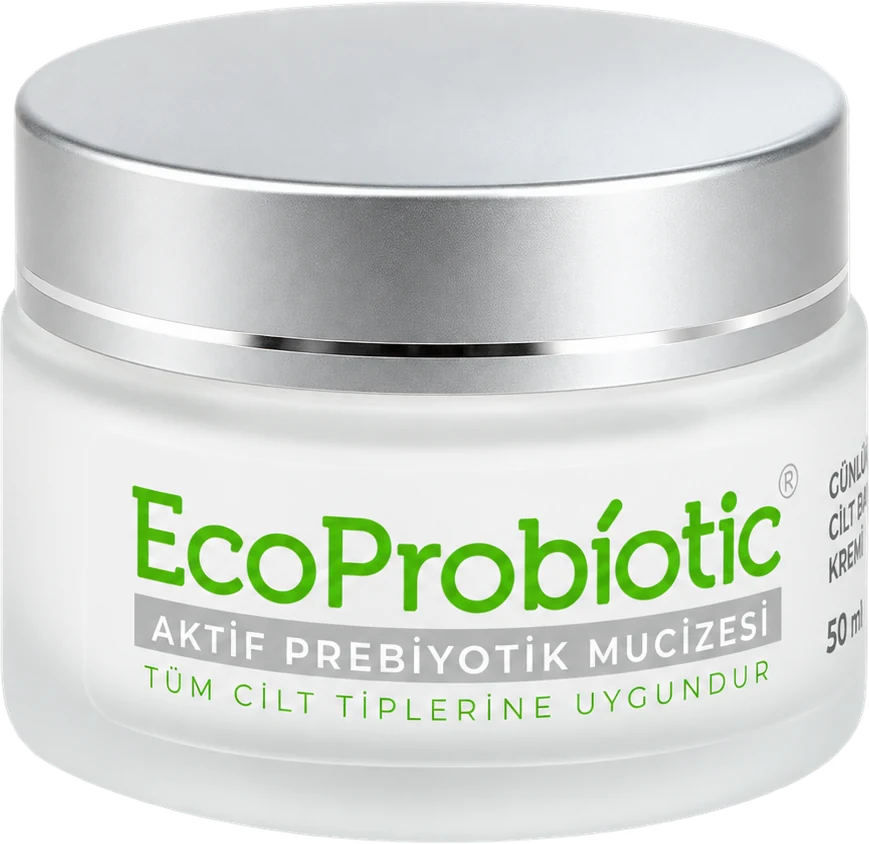 Moisturising01Prebiotic Face CreamA thin layer morning and evening; on shaving days, right after you shave. Moisturises the skin and supports its barrier.View ↗
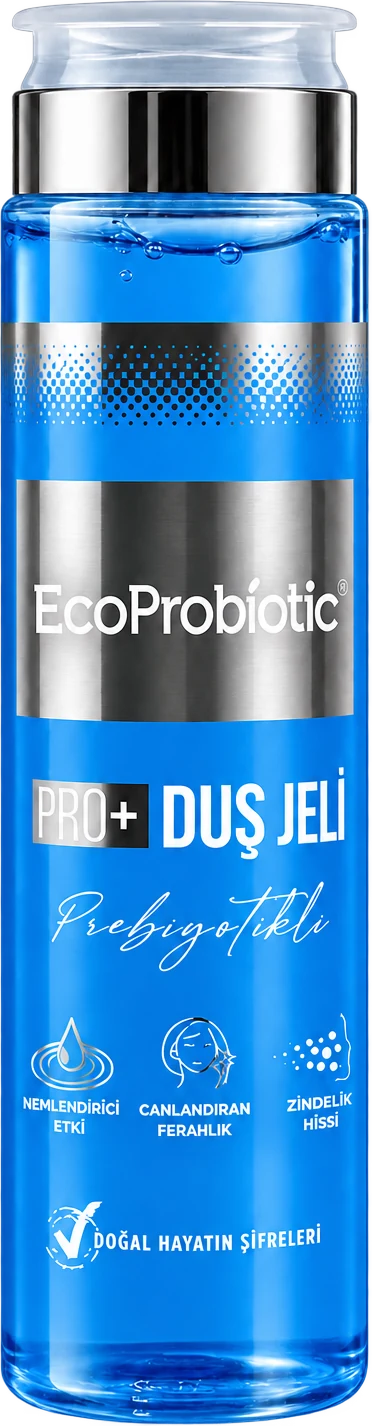 Body02Prebiotic Shower GelThoroughly cleanses the areas that hold sweat; moisturises the skin and supports its barrier. Morning or evening, every day.View ↗
Reading labels
Ingredient guide
✓What helps
- Ceramides, cholesterol and fatty acids: complete the mortar of a weakened barrier.
- Glycerin: a gentle, well-proven humectant.
- Panthenol: soothes and supports repair.
- Niacinamide: supports the barrier and redness-prone skin; start with low-concentration products.
- Allantoin: a well-tolerated ingredient that calms skin after shaving.
- Zinc oxide and titanium dioxide: mineral sun filters that are better tolerated by sensitive skin.
- Fragrance-free formulas with short ingredient lists.
- Barrier creams with prebiotic ingredients: may help support bacterial balance.
!Be careful with
- Aftershave lotions and colognes containing alcohol (ethanol).
- Fragrance, essential oils and menthol: irritation for the sake of a cooling feeling or a nice scent.
- Pressing hard with dull or rusty blades and multi-blade heads.
- Shaving against the grain and going over the same spot again and again.
- Strong acid peels, retinoids and harsh scrubs: don't start them until your skin has calmed down.
- Trying more than one new product at a time: makes it impossible to tell which one caused a reaction.
All year round
By season
Winter
Cold wind and central heating radiators weaken the barrier and increase sensitivity. Don't go outside right after shaving; use a thicker barrier cream and protect the area under your chin where your scarf rubs.
Summer
Sun, heat and sweat can trigger redness. Reapply your mineral sunscreen regularly, rinse your face with lukewarm water after sweating and keep the area under your helmet strap clean.
Seasonal transition
Sensitive skin is the type that reacts most during transitions. Avoid trying new products during this period and strip your routine down to its simplest form.
Caution
Common mistakes
- ✕Taking post-shave burning as a sign of a good shave or a lotion that works.
- ✕Going against the grain and over the same spot again and again for a closer cut.
- ✕Trying to get a few more shaves out of a dull blade.
- ✕Using menthol and alcohol-based products to cool down reddened skin.
- ✕Digging out ingrown hairs with a needle or tweezers.
- ✕Wearing your skin out further by trying a new product after every reaction.
Popular searches
Most asked about Sensitive and shave-prone skin
Your questions
Frequently asked questions
01How do I get rid of redness after shaving?+
First, stop using the things that make redness worse: alcohol-based lotion, fragrance and menthol. Rinse your face with cool water and apply an alcohol-free, fragrance-free balm with panthenol or glycerin, plus a barrier cream. Taking a few days off from shaving or switching to an electric shaver usually brings noticeable relief. If the redness is persistent, painful or comes with inflamed bumps, see a dermatologist.
02Is sensitive skin really common in men?+
Yes. Surveys from around the world show that more than half of men report some degree of sensitive skin. Men most often link their sensitivity to mechanical factors such as friction and contact; regular shaving tops the list.
03Razor or electric shaver for sensitive skin?+
An electric shaver doesn't cut as close as a blade, but it has less direct contact with the skin; for many men who struggle with razor burn and ingrown hairs, it's a more comfortable option. If you're sticking with a razor, the basic rules are a sharp blade, a creamy, fragrance-free shaving product, a single pass with the grain and no pressing.
04What causes ingrown hairs, and how can I reduce them?+
The sharp tip of a cut hair, especially curly or coarse hair, curls back and grows into the skin, causing inflamed, itchy bumps. Avoiding very close shaves and shaving against the grain, leaving the hair a little longer, removing dead cells once a week with a very mild acid and shaving less often can help. If it keeps coming back or leaves dark spots or scars, see a dermatologist.
05Why does aftershave lotion burn?+
Most classic aftershave lotions contain alcohol and fragrance. In the micro-scratches left by shaving, these substances trigger nerve endings and cause burning; over the long term they also weaken the barrier. The burning sensation isn't a good thing; switching to an alcohol-free, fragrance-free balm usually reduces the problem noticeably.
06When does sensitive skin call for a dermatologist?+
See a dermatologist if redness is persistent, if it flares up often along with visible blood vessels or acne-like bumps on your face, if burning and itching affect your daily life, or if dark spots and scars form in the shaving area. Conditions such as rosacea, contact dermatitis or beard-area inflammation need a doctor's evaluation.
Scientific basis
Sources
- 01Definition of Sensitive Skin: An Expert Position Paper from the Special Interest Group on Sensitive Skin of the International Forum for the Study of Itch.
Misery L, Ständer S, Szepietowski JC, Reich A, Wallengren J, Evers AW et al. · Acta Dermato-Venereologica · 2017 · doi:10.2340/00015555-2397
Defined sensitive skin as the occurrence of unpleasant sensations such as stinging, burning and itching in response to stimuli that normally shouldn't cause discomfort.
- 02The Prevalence of Sensitive Skin.
Farage MA · Frontiers in Medicine · 2019 · doi:10.3389/fmed.2019.00098
Pooling surveys from around the world, found that more than half of men report some degree of sensitive skin, and that sensitivity is linked to a weakened barrier and heightened nerve responses.
- 03Does sensitive skin differ between men and women?
Farage MA · Cutaneous and Ocular Toxicology · 2010 · doi:10.3109/15569521003774990
Reported that men perceive overall skin sensitivity at a severity similar to women, but cite mechanical factors such as friction and contact as the cause of their sensitivity more often than women do.
- 04The male beard hair and facial skin - challenges for shaving.
Maurer M, Rietzler M, Burghardt R, Siebenhaar F · International Journal of Cosmetic Science · 2016 · doi:10.1111/ics.12328
Described beard hair as dense, thick and coarse, and the skin around the follicles as rich in nerves, blood vessels and immune cells and able to react strongly to shaving; it also noted that men's facial skin tends to recover more slowly and to develop post-inflammatory dark spots.
- 05The biomechanics of blade shaving.
Cowley K, Vanoosthuyze K · International Journal of Cosmetic Science · 2016 · doi:10.1111/ics.12330
By measuring the forces acting on skin and hair during shaving, showed that a bad shave can trigger a marked inflammatory response, irritation and soreness in the skin, and that managing these forces matters.
- 06Insights into shaving and its impact on skin.
Cowley K, Vanoosthuyze K · British Journal of Dermatology · 2012 · doi:10.1111/j.1365-2133.2011.10783.x
Described how skin problems caused by poor shaving habits are common but often overlooked, and how issues such as nicks and ingrown hairs relate to shaving technique and tools.
- 07Pseudofolliculitis barbae; current treatment options.
Ogunbiyi A · Clinical, Cosmetic and Investigational Dermatology · 2019 · doi:10.2147/CCID.S149250
Described how inflammation in the beard area, caused by sharp-tipped hairs growing back into the skin after shaving, leads to itching, bumps and dark spots, and is more common in men with curly hair.
- 08Skin sensitivity and skin microbiota: Is there a link?
Seite S, Misery L · Experimental Dermatology · 2018 · doi:10.1111/exd.13686
Discussed a possible link between sensitive skin and imbalance in the skin microbiota, and noted that this area needs more research.